
4 Ways Specialty Coffee Brands Build Loyalty That Lasts
Specialty coffee brands don’t win on taste alone anymore. Customers are paying attention to where beans come from, how they’re roasted, and what kind of


Coffee has more or less become a necessity in our daily lives. It is the drink that wakes many people in the morning, settles into the quiet spaces between tasks, fuels conversations with clients, and occasionally closes out the evening for anyone who enjoys one last cup. It moves easily through households and generations, supporting you, your partner, your parents, and maybe even your kids if that is how your home operates.
With coffee woven into so many corners of daily life, it feels natural to pause and ask how much we really understand about its story and how this simple drink grew into such an enduring part of society. The history of coffee is not just a timeline of trade and travel. It is also a quiet record of how people adapt, share, and build rituals around something that brings comfort. It is one of those everyday habits that ends up telling us more about ourselves than we expect.

Long before roasters, espresso machines, or cafés existed, coffee was simply a plant growing wild on the hills of East Africa. People learned about it the way they learned many things in ancient times, by watching nature carefully and experimenting with what they found. The history of coffee begins with simple observations that grew into a cultural phenomenon.
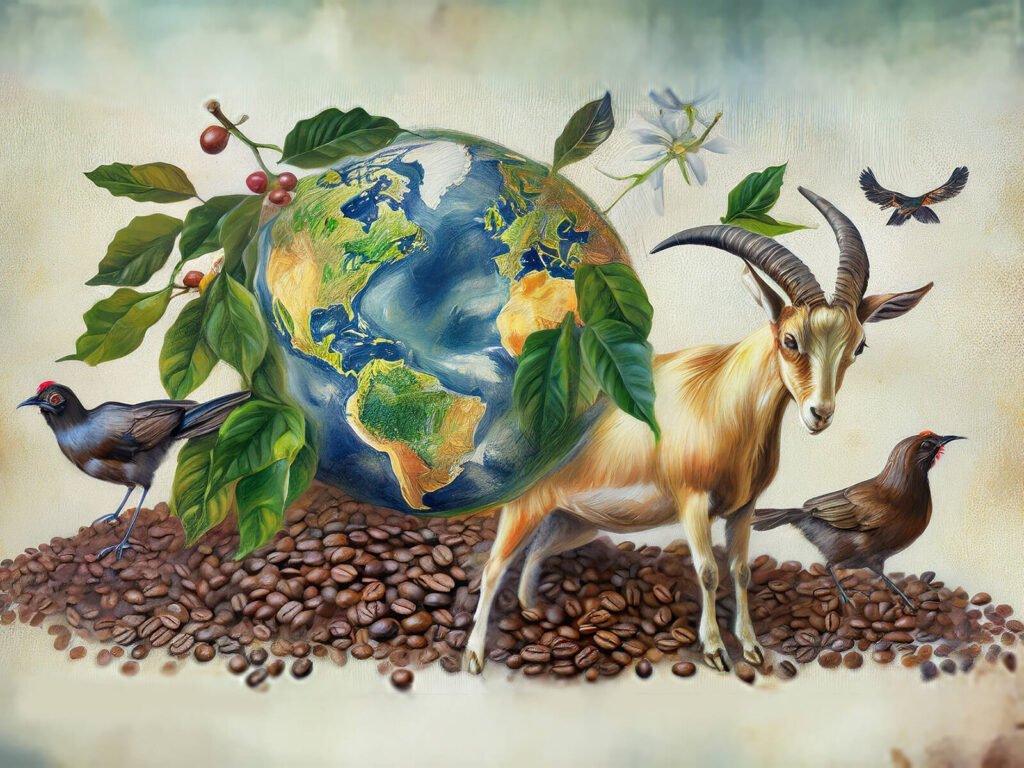
One of the earliest stories tied to coffee’s beginnings is the Ethiopian legend of Kaldi, a goat herder known for being observant and curious. According to the tale, Kaldi noticed that his goats acted strangely after eating red berries from a tree they encountered. Instead of winding down after grazing, the goats leaped and moved with unusual energy.
Wondering what caused the shift, Kaldi collected the berries and brought them to a nearby monk. The monk prepared a drink by roasting and steeping the beans. He soon found that it kept him awake through long nights of prayer. Word of this invigorating drink spread quickly among the monks, and soon others wanted to try the berries that produced such alertness. Whether the story is entirely factual or partly symbolic, it marks an early recognition of coffee’s stimulating effects.
Another well known legend traces the origins of coffee to Yemen in the Arabian Peninsula. In this story, a traveling Sufi mystic passed through Ethiopia and saw birds eating berries from a specific tree. The birds became noticeably lively. Exhausted during his journey, the mystic tried the fruit and gained immediate energy. While the details vary across retellings, the broader theme remains clear. People discovered coffee by observing nature and using simple trials to understand its benefits.
The more widely accepted historical view is that coffee beans were brought from Ethiopia into Yemen. There, farmers cultivated the plants and traders shared the drink across the region. From Yemen, the early knowledge of coffee began spreading toward the wider Middle East and parts of the Far East. The drink slowly shifted from a local curiosity to a valued source of energy.
As coffee took root in Yemen, it began to develop more defined cultural roles. Farmers learned how to dry, roast, and prepare beans with increasing skill. Traders carried beans from port cities to neighboring regions. Communities incorporated coffee into gatherings, rituals, and daily routines.

Once coffee began circulating widely, public spaces dedicated to drinking it started to appear. These coffeehouses, often called qahveh khaneh, became important hubs of social life in cities across the Middle East. People gathered to hear stories, read poetry, play music, discuss news, and exchange ideas. Coffeehouses were not merely places to drink. They were places to connect.
This rising social influence created tension at times. Some authorities felt uneasy about the conversations happening inside these lively spaces. Concerns about political talk led to occasional attempts at shutting coffeehouses down, but the closures never lasted long. People valued the drink and the community that formed around it.
The popularity of coffeehouses also hinted at something deeper in the history of coffee. The drink was not only about staying awake. It was also about bringing people together and creating environments where ideas could grow.
Coffee’s journey into Europe and the rest of the world began through the networks of the Ottoman Empire, expanding trade routes, and the movement of cultures across continents. By the sixteenth and seventeenth centuries, the drink had moved far beyond its origins.
The Ottoman Empire played a major role in spreading coffee beyond the Arabian Peninsula. Traders, travelers, and diplomats introduced the drink to cities throughout the Mediterranean. Coffee became a symbol of hospitality and sophistication. Its aroma filled marketplaces and palaces alike, and its cultural value continued to climb.
When coffee reached Europe, it created a range of reactions. Some Europeans embraced it immediately, while others viewed it with suspicion because of its association with Muslim culture. Eventually, Pope Clement VIII tried coffee and reportedly enjoyed it. His approval helped ease concerns and open the door for wider acceptance.
Once coffee gained traction in Europe, it reshaped daily life quickly. Coffeehouses emerged in major cities such as Venice, London, and Paris. These spaces served as gathering points for merchants, artists, scholars, and writers. Many important ideas, discussions, and even business concepts originated in the lively atmosphere of European coffeehouses.
As European powers expanded their reach, coffee traveled with them. The British brought coffee to new regions, and the French carried it into the Caribbean. The Dutch transplanted coffee plants to Indonesia, creating fertile new centers of cultivation. Over time, coffee spread across the Americas, Asia, and eventually the entire world. At this stage, the drink had grown into a global commodity, and the history of coffee entered a new chapter of agriculture, trade, and cultural identity.
By the eighteenth and nineteenth centuries, European countries began growing coffee in tropical climates within their colonies. This shift dramatically increased global production.
Indonesia became a key region for coffee cultivation. The Dutch established plantations on islands such as Java and Sumatra. These farms produced large quantities of beans and introduced Europe to new flavors.
France introduced coffee to Caribbean islands, where the climate proved ideal for production. Meanwhile, coffee farming expanded into Central and South America. The conditions in countries such as Brazil, Colombia, and Guatemala created some of the most productive growing regions in the world.
Brazil soon emerged as the largest coffee producer globally. Its vast land and favorable climate allowed for significant expansion. By the nineteenth century, Brazil supplied most of the world’s coffee, shaping trade networks that still exist today.
As these regions strengthened their agricultural systems, coffee became more accessible. What was once rare and expensive evolved into a drink that people all over the world could enjoy daily.

Modern coffee culture reflects both tradition and innovation. People still grow coffee in Ethiopia much as they did centuries ago. Yet the world of coffee also includes specialty roasters, advanced brewing techniques, and a wide variety of flavors and styles.
Today, coffee appears in many forms. Some drinkers seek traditional ceremonies, such as those in Ethiopia where coffee plays a role in community gatherings. Others prefer single origin beans roasted to highlight distinct tasting notes. Some choose instant coffee for convenience, while others spend time perfecting their pour over technique.
Coffee’s flexibility has helped it remain relevant across cultures and generations. It adapts to personal preference while keeping its familiar comfort.
Technology has made coffee easier to brew and easier to explore. Machines such as espresso makers, grinders, and home roasters allow people to customize their experience. Online shops let coffee lovers discover beans grown thousands of miles away without leaving home.
The history of coffee shows a steady shift toward greater accessibility. Coffee no longer moves slowly along trade routes. Instead, it can arrive at your home with a few clicks.
For all its global reach, coffee remains grounded in small moments. People drink coffee when they start their day, when they take breaks, when they meet friends, or when they unwind. The drink offers something familiar in a world that changes quickly. This simplicity has helped coffee maintain its place in society for generations.
Even with new brewing methods and a thriving specialty industry, coffee’s most important role is still connection. It brings people together, encourages conversation, and offers comfort in daily routines.
Today, getting your daily caffeine fix no longer requires travel or relying on traders crossing continents. You have access to beans from Ethiopia, Brazil, Colombia, and many other regions without leaving home.
At Equipoise Coffee, we offer a wide range of carefully selected beans that honor the long history of coffee while providing a fresh and enjoyable experience. Whether you are choosing beans for yourself or searching for a gift, our selections make it easy to enjoy quality coffee that reflects the drink’s long journey.

The history of coffee stretches from ancient legends in Ethiopia to global trade routes, from early spiritual practices to modern cafés, and from small wild berries to a worldwide industry. It reflects curiosity, resilience, cultural exchange, and the simple human desire for comfort and connection.
Each cup you drink carries echoes of this long journey. If you want to enjoy coffee that respects its roots while embracing the richness of modern roasting, explore the selections available at Equipoise Coffee. The story of coffee continues with every brew, and you are part of that history each time you pour a cup.
The earliest accounts in the history of coffee point to Ethiopia, where legends describe goats becoming energetic after eating coffee berries.
Coffee expanded through trade routes connected to the Arabian Peninsula, then moved into the Ottoman Empire, and later into Europe as demand grew.
Coffeehouses became gathering places for conversation, business, art, and community life, turning coffee into a cultural experience.
Europe widely accepted coffee by the seventeenth century, especially after Pope Clement VIII approved the drink following rising curiosity about it.
Online roasters like Equipoise Coffee offer a variety of beans from around the world, making it easy to sample new flavors and origins.
Specialty coffee brands don’t win on taste alone anymore. Customers are paying attention to where beans come from, how they’re roasted, and what kind of

Water processed decaf coffee promises rich taste without chemicals, but what makes it stand out among other caffeine-free options?

Community loyalty in retail and hospitality doesn’t happen by accident. It’s built on purpose, inside physical spaces that give people something more than speed or

Growing a specialty brand is rarely just about selling more. Expansion brings real tension between speed, reach, and the standards that made the brand valuable

Craft-focused small businesses have always relied on care, precision, and sourcing to stand out. What’s changing now is how those values are shown, not just

How can brands create a more balanced and memorable customer experience by blending artisanal product quality with thoughtful everyday rituals that keep people coming back?

Independent coffee shops have always been about more than caffeine—they’re hubs of creativity, connection, and care. As café culture continues to evolve, new trends are

Introduction Independent cafes win when they feel like the neighborhood’s living room and operate with the discipline of a great kitchen. Below is a quick

Discover how top specialty coffee brands create lasting loyalty through storytelling, sourcing, and community connection. Real tips from 6 industry experts.